
3D Papad Making Plant: A Complete Guide for Food Manufacturers
Explore a 3D Papad Making Plant for snack manufacturing. Learn about the production process, machine features, benefits, pricing factors, and how to choose the right setup for your business.
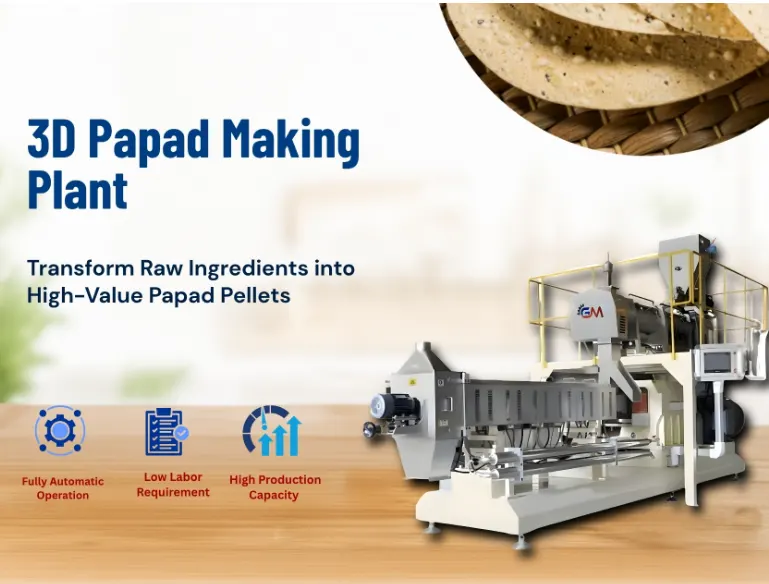
What Is a 3D Papad Making Plant?
A 3D Papad Making Plant is a food processing setup that manufactures shaped snack pellets from suitable raw materials, such as wheat flour and starch-based formulations. These pellets are formed into different three-dimensional shapes and prepared for subsequent processing.
Traditional papad is a thin, flat product, whereas 3D snack pellet manufacturing focuses on producing shaped intermediate products that can expand or develop their intended texture during further processing, depending on the formulation and manufacturing method. If you are looking for equipment to make flat papad, a 3D snack pellet line is not the right choice.
A complete 3D Papad Making Plant may include dough mixing, feeding, extrusion or shaping, conveying, drying, and other processing equipment, depending on production requirements. Additional equipment for frying, seasoning, cooling, and packaging may be incorporated to create a more comprehensive production setup.
For food manufacturers, selecting the right machinery involves considering the intended snack products, required output, available factory space, and the level of automation needed.
How Does a 3D Papad Making Machine Work?
A 3D Papad Making Machine uses a controlled processing method to transform prepared raw materials into shaped snack pellets. The exact sequence depends on the machine configuration, product formulation, and the desired shape and texture.
The following are the main stages commonly involved in 3D snack pellet production.
1. Raw Material Selection and Preparation
The process begins with selecting suitable ingredients for the intended product. Wheat flour, starch, and other food-grade ingredients may be used according to the formulation.
Measure and prepare the raw materials appropriately to achieve a consistent mixture. Ingredient quality and formulation control are important because they influence the processing behaviour, shape, and final characteristics of the snack pellets.
2. Dough Mixing
The selected ingredients are mixed to create a uniform dough or processing mixture suitable for the machine.
Consistent mixing helps the material move through the production system more predictably. The required moisture level and mixing conditions depend on the recipe and equipment design.
3. Extrusion and Shaping
During this stage, the prepared material is processed through the forming mechanism to create the required three-dimensional shapes.
The choice of dies and machine configuration influences the available product designs. Manufacturers should discuss their preferred shapes and product specifications with the equipment supplier before finalising the machinery.
4. Conveying and Drying
After shaping, the formed pellets may move through conveyors and drying equipment, depending on the production line configuration.
Drying helps prepare the shaped pellets for subsequent processing and storage. The appropriate drying conditions depend on the formulation, moisture content, pellet dimensions, and desired product characteristics.
5. Final Processing
The dried pellets can be further processed using suitable equipment, such as fryers or roasters, according to the intended snack product.
Seasoning and flavour application may also be included when required. If the business intends to sell packaged ready-to-eat snacks, cooling and packaging equipment can form part of the overall manufacturing arrangement.
What Are the Benefits of an Automatic 3D Papad Making Machine?
An Automatic 3D Papad Making Machine can help manufacturers organise production, reduce repetitive manual work, and maintain greater process consistency when properly configured and operated.
The key benefits depend on the selected model, production capacity, operating conditions, and the requirements of the business.
Improved Production Efficiency
An automated production setup can coordinate multiple processing stages and reduce the need for repetitive manual handling. This can help businesses manage production more efficiently as their manufacturing requirements increase.
Consistent Product Shapes
A suitable shaping system and correctly selected dies help manufacturers produce repeatable product designs. Consistency is important when developing a product range for retail distribution, food service, or private-label snack brands.
Reduced Manual Intervention
Automation can reduce the amount of manual work required for selected production operations. Actual labour requirements depend on the level of automation, material handling arrangements, and whether drying, frying, seasoning, and packaging are integrated into the line.
Product Variety
A suitably configured 3D Papad Making Machine can support different shaped snack pellet products through appropriate tooling and process adjustments. Manufacturers should confirm the available shapes and changeover requirements before purchasing equipment.
Better Production Planning
A properly designed production line helps businesses coordinate raw material preparation, shaping, drying, and subsequent processing. This can make it easier to plan production schedules and monitor output.
Scope for Business Expansion
A scalable 3D Papad Making Plant can help manufacturers explore new product variations and respond to changing business requirements. Capacity planning should account for the output of individual machines, drying requirements, downstream processing, and packaging speed.
How to Choose the Right 3D Papad Production Line
Selecting the right 3D Papad Production Line is an important decision for any food manufacturer. Machinery should match the business’s production targets, product requirements, available resources, and long-term plans.
1. Define Your Required Production Capacity
Start by determining the amount of snack pellets you intend to manufacture per hour or per shift.
A small operation may have different requirements from a large-scale snack factory supplying distributors or retail brands. Compare the rated capacity of the equipment with your expected production volume and clarify the actual output achievable for your intended product.
2. Check the Available Product Shapes
The range of products you plan to manufacture will influence the type of shaping equipment and dies required.
Discuss your intended shapes, pellet dimensions, and formulation with the manufacturer. Confirm whether additional tooling is needed for product changes and how much time is required for changeovers.
3. Evaluate Automation Requirements
Consider whether your business needs a fully automatic setup or a production arrangement with selected manual operations.
An automatic system may be suitable for businesses seeking coordinated production, while other configurations may better suit specific operational requirements. Evaluate labour availability, operator training, maintenance, and production targets before making a decision.
4. Assess Material Quality and Construction
Food processing equipment should be selected with attention to construction materials, cleanability, durability, and suitability for the intended application.
Growmax International’s product page describes its 3D papad snacks pellet machinery as featuring stainless steel construction. Ask the manufacturer to confirm the material grades used in product-contact areas and the cleaning and maintenance procedures recommended for your selected model.
5. Consider Space and Utility Requirements
A 3D snack pellet production line may require space for raw material storage, mixing, forming, conveying, drying, and any downstream processing equipment.
Before installation, evaluate the available factory layout, electrical supply, ventilation, material movement, and access for maintenance. Request a complete layout and utility requirement sheet from the supplier.
6. Review Installation and After-Sales Support
Reliable technical assistance is an important consideration when purchasing industrial food processing machinery.
Check whether the supplier provides installation guidance, operator training, troubleshooting assistance, spare parts, and after-sales service. These services can help your team operate and maintain the equipment more effectively.
What Factors Affect the 3D Papad Machine Price?
The 3D Papad Making Machine price varies according to the machine configuration and the requirements of the manufacturing business. Rather than comparing equipment on its initial price alone, buyers should evaluate the overall cost of establishing and operating the production line.
Several factors influence the investment.
Production Capacity
Machines designed for different hourly output requirements may differ in size, power consumption, and processing configuration. Choose a capacity that meets your production targets without overlooking downstream processing limitations.
Level of Automation
The level of automation can influence the initial investment, operating requirements, and integration of different production stages. Compare the functions included in each configuration before making a purchase decision.
Production Line Configuration
A basic forming machine and a complete production line are not necessarily equivalent investments. Mixing, conveying, drying, frying, seasoning, cooling, and packaging equipment may affect the overall project cost.
Product Shape and Tooling
The intended pellet shapes and the number of product variations may influence tooling requirements and associated costs. Confirm which dies and accessories are included in the quotation.
Installation and Technical Services
Installation, commissioning, operator training, transportation, and other support services may affect the total project investment. Clarify which services are included in the supplier’s offer.
Operating and Maintenance Costs
Electricity, raw materials, labour, cleaning, maintenance, and replacement parts contribute to the ongoing cost of production.
For an accurate quotation, share your intended product, required production capacity, automation preference, and desired level of processing with the manufacturer.
Why Choose Growmax International as Your 3D Papad Making Machine Manufacturer?
Choosing an experienced 3D Papad Making Machine manufacturer can help you identify machinery that matches your production goals and operational requirements.
Growmax International offers food processing machinery, including 3D snack pellet and papad-making solutions for businesses looking to develop or expand their snack manufacturing capabilities.
Machinery Designed for Snack Production
Growmax International provides machinery for producing 3D snack pellets and papad-style snack products. Discuss your intended raw materials, pellet shapes, and production targets to identify a suitable machine configuration.
Production-Focused Equipment Selection
Every snack manufacturing business has different requirements. Production capacity, available floor space, automation, and the desired end product should be considered when selecting equipment.
Growmax International can be contacted to discuss your application and determine the appropriate configuration for your business.
Installation and Technical Assistance
Setting up industrial machinery involves more than purchasing equipment. Installation guidance, operator training, and access to technical support are important considerations when planning a new production facility.
Ask the Growmax International team about the installation arrangements and after-sales services available for your selected machine.
Support for Long-Term Operations
Machine maintenance, troubleshooting, and spare parts availability can affect production continuity. Before purchasing, discuss the recommended maintenance schedule and the technical assistance available for your operating location.
A Partner for Your Manufacturing Requirements
Whether you are starting a snack manufacturing venture or expanding an existing food processing facility, working with a machinery supplier that understands your requirements can help you plan the next steps with greater clarity.
Understanding the Snack Pellet Making Machine Market
A Snack Pellet Making Machine is used to manufacture intermediate snack products that undergo further processing before consumption. These products can be developed in different shapes and formulations to serve various snack categories.
For businesses entering this segment, the important considerations include product development, processing requirements, packaging, distribution, and target customers.
Product Development Opportunities
Three-dimensional snack pellets provide manufacturers with opportunities to develop visually distinctive snack products. Shape, texture, seasoning, and final processing can be adjusted according to the product concept and the capabilities of the equipment.
Before commercial production, manufacturers should conduct product trials to evaluate shape retention, expansion, texture, moisture, and finished-product quality.
Production Planning and Quality Control
A successful manufacturing operation requires consistent raw materials, controlled processing conditions, proper cleaning, and routine quality checks.
Businesses should establish appropriate procedures for ingredient handling, moisture control, finished-product inspection, and storage. Food safety requirements must be followed throughout the production process.
Packaging and Distribution
Packaging is an important part of the overall snack manufacturing plan. The selected packaging method should protect the finished product from moisture and damage while maintaining its intended quality during storage and distribution.
Manufacturers should also consider packaging capacity, shelf-life validation, labelling requirements, and their target distribution channels.
How to Plan a Snack Pellet Manufacturing Investment
A snack pellet manufacturing machine should be selected as part of a broader business and production plan rather than as an isolated equipment purchase.
The following steps can help you evaluate the investment.
Step 1: Identify Your Target Market
Determine the types of snack products you want to sell and the customers you intend to serve. Your target market will influence product design, production volumes, packaging, and distribution requirements.
Step 2: Finalise Your Product Specifications
Define the intended pellet shapes, dimensions, raw materials, and processing requirements. Where possible, discuss sample products and conduct trials with the machinery supplier before finalising your configuration.
Step 3: Estimate Production Requirements
Calculate your expected daily or monthly production volume. Include operating hours, planned downtime, material availability, and the capacity of downstream equipment.
Step 4: Compare Machinery Quotations
Request quotations that clearly identify the machine configuration, rated capacity, included accessories, power requirements, warranty, delivery, and installation arrangements. Comparing quotations on the same basis can help you understand the differences between available options.
Step 5: Calculate Operating Costs
Estimate the expected expenditure on ingredients, electricity, labour, packaging, maintenance, and other operating requirements. A realistic cost assessment will help you evaluate the financial feasibility of the proposed production setup.
Step 6: Plan for Future Expansion
If you expect your business to grow, consider whether the selected production arrangement can accommodate additional output or product variations. Future expansion should be planned alongside factory space, utilities, staffing, and packaging capacity.