
Noodle Production Machine: A Complete Guide for Food Manufacturers
Explore how a Noodle Production Machine works, its key benefits, production process, features, and price factors for food manufacturers in India.
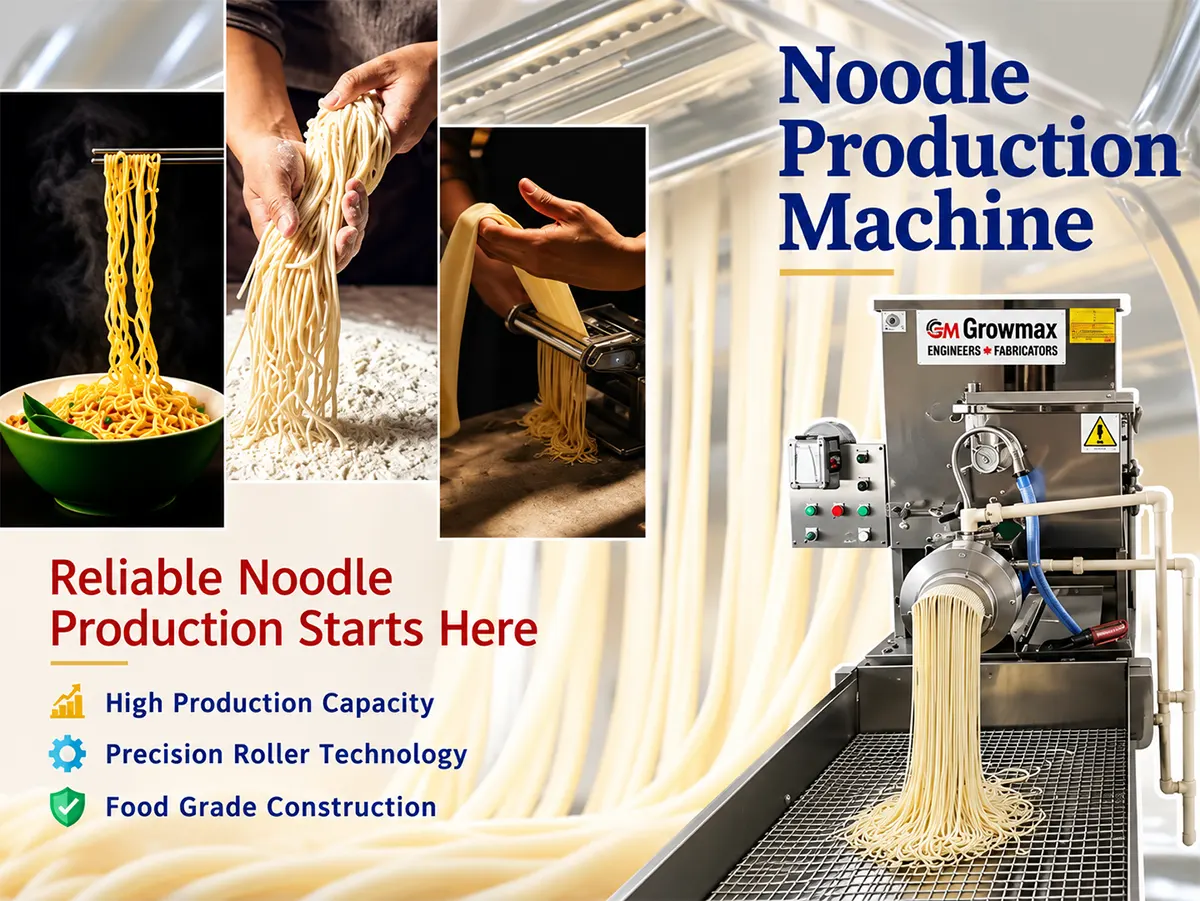
What Is a Noodle Production Machine?
A Noodle Production Machine is industrial equipment used to manufacture noodles from ingredients such as wheat flour, water, and other recipe-specific components. Depending on the machine design, it can perform individual operations or integrate multiple stages into a production line.
Commercial noodle manufacturing equipment is available in different configurations to meet the requirements of small businesses, medium-sized manufacturers, and large food processing facilities.
Modern automatic systems can reduce repetitive manual work, improve process control, and support consistent production when operated with suitable raw materials and settings.
Types of Noodles That Can Be Manufactured
The type of noodle you plan to produce determines the machine configuration and processing requirements.
Instant noodles: Designed for quick preparation and commonly sold in packaged formats.
Traditional wheat noodles: Suitable for different regional recipes and cooking applications.
Non-fried noodles: Processed using an appropriate drying system instead of deep frying.
Fried instant noodles: Require a frying stage as part of the manufacturing process.
Specialty noodles: Products made with alternative flours, different thicknesses, or customised shapes may require specific dies, rollers, or processing adjustments.
Manufacturers should confirm product compatibility with the machinery supplier before finalising their investment.
How Does a Noodle Production Machine Work?
A noodle production line transforms selected ingredients into finished noodles through a series of controlled operations. The exact sequence depends on whether the manufacturer produces instant noodles, fresh noodles, or another noodle variety.
1. Raw Material Preparation
The process begins with selecting and measuring the required ingredients. Wheat flour, water, salt, and other recipe ingredients are prepared according to the product formulation.
Consistent ingredient quality and accurate measurements help maintain the desired texture and processing performance.
2. Dough Mixing and Kneading
The ingredients are mixed to form a uniform dough. Proper mixing distributes moisture and ingredients throughout the mixture, preparing it for the next manufacturing stage.
The mixing time and moisture level depend on the recipe and machine specifications.
3. Dough Sheeting or Extrusion
Depending on the equipment design, the prepared dough is passed through rollers to form thin sheets or processed through an extrusion system.
The selected method influences the noodle’s thickness, texture, shape, and overall production characteristics.
4. Noodle Cutting and Shaping
The dough sheets are cut into strands of the required width and length. Specialised cutting arrangements or dies can be used to achieve different product specifications.
Accurate cutting helps manufacturers maintain uniformity across production batches.
5. Steaming or Cooking
For instant noodle production, the shaped noodles may undergo steaming to partially cook the product and develop the desired structure.
The required treatment depends on the noodle type and the intended finished product.
6. Frying or Drying
Instant noodles can be processed through frying or an appropriate hot-air drying system, depending on the desired product.
Frying and non-fried drying require different equipment configurations and process controls. Manufacturers should choose the system that matches their recipe, nutritional positioning, and target market.
7. Cooling and Packaging
After the required processing, noodles are cooled and prepared for packaging. Packaging equipment may weigh and seal the finished product into pouches, packets, or cups, depending on the packaging format.
Proper packaging helps protect the product during storage and distribution. Shelf life depends on factors such as moisture content, packaging quality, formulation, and storage conditions.
Key Features to Look for in a Noodle Production Machine
Selecting machinery with the right features can help improve production efficiency and simplify routine operations.
Automatic Operation
An automatic noodle production system can reduce manual intervention in compatible processing stages. This can help manufacturers manage repetitive tasks and maintain a more consistent production workflow.
Suitable Production Capacity
Production capacity is one of the most important factors when purchasing industrial equipment. Manufacturers should evaluate their expected output, working hours, market demand, and future expansion plans.
Choose a machine based on its rated capacity and the actual output achievable with your specific product.
Consistent Noodle Quality
Uniform dough preparation, accurate cutting, and controlled processing conditions help maintain consistent noodle thickness, shape, and texture.
A suitable machine configuration can make it easier to reproduce product specifications across batches.
Easy Operation and Process Control
User-friendly controls can simplify routine operation and help operators manage parameters such as speed and temperature where applicable.
The availability of training, technical documentation, and after-sales support should also be considered.
Hygienic Construction and Easy Cleaning
Food processing equipment should be designed to support effective cleaning and hygienic operation. Manufacturers should verify the materials used in product-contact areas and ensure that the equipment meets the applicable food safety and regulatory requirements.
Maintenance and Spare Parts Availability
Regular maintenance helps reduce unexpected downtime and supports long-term equipment performance. Before purchasing, confirm the availability of spare parts, servicing, installation assistance, and operator training.
Benefits of Using an Automatic Noodle Production Machine
Investing in suitable automated machinery can offer several operational advantages for commercial food manufacturers.
1. Improved Production Efficiency
Automating suitable stages of noodle manufacturing can help streamline production and reduce delays between operations.
2. Reduced Manual Work
Automatic systems can reduce repetitive manual tasks, allowing staff to focus on monitoring, quality control, and other essential production activities.
3. Consistent Product Specifications
Controlled processing and accurate cutting help manufacturers maintain consistent product dimensions and quality, provided the machine is configured and operated correctly.
4. Better Production Planning
A machine selected according to business requirements can help manufacturers organise daily output, manage production schedules, and plan raw material requirements more effectively.
5. Scope for Business Expansion
As demand increases, businesses can evaluate higher-capacity equipment or additional processing and packaging systems to expand their manufacturing operations.
6. Improved Process Management
Integrated equipment can reduce unnecessary handling between production stages and help create a more organised manufacturing workflow.
The actual benefits depend on the machine configuration, operating conditions, maintenance practices, and production volume.
How to Choose the Right Noodle Production Machine for Your Business
Choosing the right machine requires more than comparing prices. Manufacturers should assess their production goals and technical requirements before making a purchase.
Define Your Product Range
Decide whether you want to manufacture instant noodles, traditional noodles, fried noodles, or non-fried varieties. Each product may require different processing arrangements.
Determine Your Required Capacity
Estimate your daily and monthly production targets. Consider current demand and expected business growth to avoid selecting equipment that is either undersized or unnecessarily large.
Evaluate Automation Requirements
Compare manual, semi-automatic, and automatic configurations based on labour availability, production volume, budget, and the level of process control required.
Check Space and Utility Requirements
Review the installation area, electrical supply, ventilation, water requirements, and other utilities needed for the selected machine. Ensure that sufficient space is available for operation, cleaning, maintenance, and material movement.
Assess Installation and Technical Support
A dependable machinery supplier should clearly explain installation requirements, operator training, maintenance procedures, and service arrangements.
Compare the Total Cost of Ownership
Consider the purchase price alongside installation, electricity consumption, labour, maintenance, spare parts, raw material usage, and packaging expenses.
A machine with a lower initial cost may not necessarily offer the best long-term value if its operating expenses are higher.
Instant Noodle Making Machine Price in India: What Determines the Cost?
The instant noodle making machine price in India varies according to machine specifications, production capacity, automation level, and the scope of the supplied equipment.
Businesses should compare quotations based on equivalent technical requirements rather than relying only on the initial price.
Production Capacity
Higher-capacity machines may require larger processing systems and additional supporting equipment. This can affect the overall investment.
Level of Automation
A system that integrates several production stages may cost more than a machine designed for a single operation. However, the appropriate choice depends on the manufacturer’s workflow and production needs.
Frying or Non-Fried Processing
A production line designed for fried instant noodles may require a fryer and associated systems. Non-fried products may require a suitable drying arrangement instead.
These differences can influence the equipment configuration and total project cost.
Packaging Integration
Some businesses purchase noodle-making machinery separately from packaging equipment, while others prefer a more integrated setup. Packaging speed, pack format, and automation can affect the total investment.
Installation and After-Sales Support
Installation, operator training, transportation, warranty coverage, and servicing arrangements should be checked when evaluating quotations.
For an accurate price estimate, contact Growmax International with your required production capacity, noodle type, automation preferences, and packaging requirements.
Why Choose Growmax International for Noodle Production Machinery?
Growmax International supplies food processing machinery for businesses looking to establish or expand their manufacturing operations. Its product range includes noodle-making equipment and an automatic noodle extruder machine.
When evaluating a Noodle Production Machine, businesses should consider the equipment’s suitability for their intended product, the required production capacity, and the technical support available from the supplier.
Growmax International can be contacted to discuss machinery requirements and identify an appropriate configuration for your manufacturing goals.
Before confirming an order, ask for the latest machine specifications, rated production capacity, material details, utility requirements, and a quotation covering the equipment and any additional systems required.
Explore the product range: Noodle Making Machine by Growmax International
Applications of Noodle Production Machines
Noodle production equipment can support a range of commercial food manufacturing operations.
Food Processing Companies
Established food processing companies can use suitable machinery to streamline noodle production and manage consistent product output.
Instant Food Manufacturers
Businesses producing packaged instant noodles may require integrated mixing, shaping, steaming, drying or frying, and packaging operations.
Private Label and Contract Manufacturers
Contract manufacturers can evaluate suitable equipment for producing noodles according to client specifications, subject to machine capabilities and production requirements.
New Food Manufacturing Businesses
Entrepreneurs planning to enter the packaged food industry can assess noodle production equipment as part of their overall business plan, considering market demand, distribution, food safety, and operating costs.